


Your Guide to Toyota Loans & Leases in Lawrence Township
Your Guide to Toyota Loans & Leases in Lawrence Township
Author: Team Toyota of Princeton
Choosing the right Toyota is an important decision for navigating life in Mercer County, whether you’re tackling the daily commute on Route 1 or heading to the Delaware and Raritan Canal State Park for a weekend adventure. Just as crucial is deciding how you’ll pay for it. The world of auto finance, with its talk of APRs, residuals, and equity, can feel as complex as navigating the Quaker Bridge Mall parking lot on a Saturday. At Team Toyota of Princeton, our deep roots in the community mean we’ve spent years helping our neighbors from Princeton, Ewing Township, and beyond make sense of these options. Drawing on our extensive experience detailed on our About Us page, we’ve created this guide to demystify the choice between financing and leasing, ensuring you can make a smart, confident decision that suits your New Jersey lifestyle.
Key Takeaways (TL; DR)
- Ownership vs. Flexibility: Financing a Toyota is the path to full ownership, letting you build equity over time. Leasing offers lower monthly payments and the freedom to drive a new vehicle every few years, perfect for those who prioritize the latest features.
- Credit’s Critical Role: Your credit score is the single most important factor in determining your interest rate. A higher score typically unlocks more favorable financing terms, saving you money over the life of your loan or lease.
- The Toyota Financial Services Edge: As Toyota’s dedicated finance partner, Toyota Financial Services (TFS) offers exclusive rates and loyalty programs that often can’t be matched by traditional banks or credit unions.
- End-of-Lease Options: A lease provides three clear choices at its conclusion: you can buy your Toyota, lease a brand-new 2026 model, or simply return the vehicle and walk away, offering unparalleled adaptability to life’s changes.
- Local Driving Considerations: Your daily driving habits in areas like Hamilton Township or Hillsborough Township should guide your choice. High-mileage commuters may find financing more cost-effective, while those with shorter, local drives might prefer the benefits of leasing.
- Preparation Streamlines the Process: Arriving at the dealership with necessary documents like proof of income, residency, and insurance can speed up the approval process and put you in a stronger position.
What is the purpose of financing a car?
For many drivers in Lawrence Township, financing is the traditional and most familiar way to acquire a new vehicle. Is this long-established method the best route to putting a new Toyota in your driveway? The process involves securing a loan from a financial institution to cover the vehicle’s purchase price, less any down payment you provide. This loan is then repaid in monthly installments over a predetermined period, which can range from 36 to 84 months. Lenders can include national banks, local credit unions in Princeton, or, most commonly, Toyota’s own financial arm, Toyota Financial Services.
The fundamental advantage of financing is the destination: complete ownership. Each payment you make chips away at the loan balance while building your equity in the vehicle. After the final payment is made, the lender’s lien is removed from the title, and the car belongs entirely to you. This is a powerful draw for drivers who see their vehicle as a long-term asset. If your plan involves driving your 2026 Tundra for the next decade, or if you want the freedom to customize your vehicle for local conditions—like adding all-weather tires for unpredictable New Jersey winters—financing is the most logical choice. It provides a sense of permanence and the freedom that comes with true ownership.
How does Toyota Financial Services (TFS) benefit buyers?

Why should you consider using the manufacturer’s lender instead of your local bank? Toyota Financial Services isn’t just another financial entity; it’s a captive lender created specifically to support the sale and lease of Toyota vehicles. This integrated relationship between the manufacturer and the financing arm creates a streamlined process that often results in significant benefits for the customer. TFS collaborates directly with dealerships like Team Toyota of Princeton, making the entire transaction smooth and efficient.
When you’re ready to discuss financing for a 2026 Highlander or Corolla, the application for TFS is woven directly into our dealership’s process. We submit your financial profile to TFS, which has a deep understanding of the true value and durability of the vehicles they are financing. This specialized knowledge allows them to be more competitive with their offers. More importantly, TFS is the channel through which Toyota offers special promotional APRs—like 1.9% or 2.9% financing—that are subsidized by the manufacturer to boost sales. These are rates that a general lender in Hamilton Township typically cannot offer. For a broader overview of auto financing, you can visit resources like Edmunds.
What does a car lease agreement actually entail?
Is leasing simply a long-term rental? While it shares similarities, leasing is more accurately described as paying for the use of a vehicle during its most trouble-free years. When you finance, your payments cover the vehicle’s total cost. In a lease, your payments cover the vehicle’s depreciation—the calculated difference between its initial price and its projected “residual value” at the end of the lease term, usually 24 or 36 months. In addition to depreciation, you also pay a “money factor,” which functions like an interest rate, along with applicable taxes and fees.
This structure is why lease payments are typically much lower than loan payments on an identical vehicle. You are only paying for a portion of the car’s value. This financial advantage makes leasing particularly appealing for drivers in Ewing Township and Princeton who value having the latest automotive technology. If you want the most up-to-date safety features for navigating Route 206 or the newest infotainment system for your commute, leasing allows you to upgrade every few years. This cycle of renewal ensures you are always driving a vehicle that is under the manufacturer’s factory warranty, protecting you from the unexpected repair costs that can arise as a car ages, especially with the wear and tear from New Jersey’s varied climate.
What are my options when a lease term concludes?
What happens when your lease contract is over? One of the most compelling aspects of leasing is the flexibility it affords you at the end of the term. You are not locked into a single outcome. When your agreement with Toyota Financial Services ends, you are presented with three distinct options, each designed to adapt to your evolving needs as a driver in the Lawrence Township area.
- Lease Buyout: You may have grown attached to your 2026 Camry. It navigated the winter slush on I-295 with ease, and you’ve kept it in excellent condition. You have the contractual right to purchase the vehicle for its pre-determined residual value. If the market for pre-owned vehicles is strong and your car is worth more than this residual price, buying it out can be a very wise financial decision, allowing you to capture that equity.
- Upgrade to a New Toyota: This is the most popular choice for lessees. You simply return your current vehicle to Team Toyota of Princeton and select a new one. This transition is designed to be seamless. You get to enjoy a brand-new car with a fresh warranty, and Toyota often provides loyalty incentives, such as waiving your disposition fee or offering special terms on your next lease or purchase.
- Walk Away: Perhaps your circumstances have changed. Maybe you’re moving to an area with robust public transportation or your household no longer needs an extra car. You can return the vehicle, have it inspected for any excess wear or mileage, settle any final fees, and walk away. This option eliminates the hassle of selling a car privately or negotiating a trade-in value.
How do financing and leasing compare directly?

To make an informed decision, it’s essential to look past the monthly payment and understand the fundamental differences between these two financial paths. Think of financing as a long-term investment strategy that culminates in ownership. Leasing, on the other hand, is a subscription-based approach that prioritizes lower costs and access to new technology.
For a driver in Hillsborough Township with a long daily commute into the Princeton-Plainsboro area, racking up 18,000 miles per year, leasing might be less practical due to mileage restrictions. In contrast, for someone in Lawrence Township who primarily drives locally for errands and short trips, the lower payments and convenience of leasing could be an ideal fit.
Key Comparison Points:
Path to Ownership:
- Financing: You are the owner. Once the loan is paid off, the title is yours.
- Leasing: The leasing company holds the title. You are effectively a long-term renter.
Impact on Monthly Budget:
- Financing: Payments are higher because you are paying off the entire value of the vehicle plus interest.
- Leasing: Payments are lower because you are only covering the depreciation and associated charges.
Upfront Costs:
- Financing: A down payment of 10-20% is often recommended to secure better rates and avoid negative equity.
- Leasing: Costs due at signing typically include the first month’s payment, a security deposit, an acquisition fee, and taxes. A down payment (cap cost reduction) is optional.
Customization and Modifications:
- Financing: The car is yours to modify as you see fit.
- Leasing: The vehicle must be returned in its original, factory condition to avoid penalties.
Mileage Considerations:
- Financing: There are no mileage restrictions. Drive as much as you want.
- Leasing: Contracts include strict annual mileage limits (e.g., 10,000, 12,000, or 15,000 miles). Exceeding these limits results in per-mile charges.
Wear and Tear:
- Financing: Dents and scratches affect your car’s resale value, but you won’t be charged for them by a lender.
- Leasing: The vehicle must be returned within the condition standards of “normal wear and use.” Excess damage will result in fees.
Future Value:
- Financing: You build equity and have an asset to trade or sell.
- Leasing: You end the term with no equity, unless you opt for a buyout.
What factors shape my financing or lease terms?
How does a lender decide on the rate and terms you receive? The offer you get is not arbitrary; it’s the result of a detailed risk assessment based on your financial history. Understanding these key variables can empower you to secure a more favorable deal when you visit our dealership.
- The Power of Your Credit Score: This is the most influential factor. Your credit score serves as a snapshot of your reliability as a borrower. Lenders view scores above 720 as indicative of a low-risk applicant, deserving of the most competitive interest rates (APRs). Scores below the mid-600s may be considered higher risk, potentially leading to higher rates or the requirement of a co-signer.
- The Significance of a Down Payment: Putting money down at the start reduces the amount you need to borrow, which lowers the lender’s risk. For financing, a larger down payment can help you qualify for better interest rate tiers. In a lease, a down payment (capitalized cost reduction) will lower your monthly payment, but many experts advise against large down payments on leases, as that money could be lost if the vehicle is totaled early in the term.
- The Length of the Term: The loan or lease duration has a direct impact on your payments and total cost. Longer financing terms (72 or 84 months) result in lower monthly payments but increase the total amount of interest you pay. Shorter terms (36 or 48 months) have higher payments but can save you thousands in interest over time.
- Your Debt-to-Income (DTI) Ratio: Lenders analyze your total monthly debt payments (mortgage, credit cards, etc.) relative to your gross monthly income. A high DTI ratio may cause concern about your ability to manage an additional car payment, even if you have a strong credit score.
Are there special financing programs for Toyota buyers?
Can certain drivers in our community access unique savings opportunities? Toyota understands that reliable transportation is a key part of major life transitions. To assist, Toyota Financial Services offers several targeted rebate programs that provide real cash savings, which can be applied toward your purchase or lease.
- The College Graduate Program: For recent or upcoming graduates from local institutions like Princeton University, The College of New Jersey, or Rider University, securing a reliable car is a crucial step in starting a career. Toyota offers a rebate for qualified graduates, acknowledging that they may have a bright future but a limited credit history.
- The Military Rebate Program: We hold deep respect for the members of our armed forces. Eligible U.S. military personnel, including active-duty members, reservists, and recent retirees in our community, can receive a special rebate as a token of our appreciation for their service.
- Loyalty Rewards: If you’re already a Toyota driver, the brand rewards your loyalty. Returning lessees often qualify for benefits like waived disposition fees or loyalty cash that can be applied to their next Toyota lease or purchase. You can find current program details on the official Toyota Financial Services website.
What is the step-by-step process for getting approved?

How do you navigate the application process to secure your new Toyota? While paperwork is part of the journey, modern technology has made the path to approval smoother than ever. You can even begin the process from the comfort of your home in Hamilton Township.
Step 1: Online Pre-Qualification
Visit our dealership website or the TFS portal to complete a pre-qualification form. This is typically a “soft” credit pull, which won’t affect your credit score but gives you a clear idea of your potential purchasing power.
Step 2: Gather Your Documents
To finalize a loan or lease, lenders need to verify your identity and financial standing. You’ll need a valid New Jersey driver’s license, recent pay stubs, proof of residency (like a utility bill), and proof of auto insurance.
Step 3: Submit the Formal Application
This detailed application covers your employment, income, and housing information. Submitting it authorizes a “hard inquiry” on your credit report, which is a necessary step for the lender to provide a firm offer of credit.
Step 4: Review Your Contract
Once you are approved, our finance manager will walk you through the terms, including the APR, term length, monthly payment, and any optional protection products. This is your opportunity to ask questions and ensure you understand every detail before signing.
Is paying with cash a better option than financing?
Is it always best to buy a car outright if you have the funds? While paying cash provides the satisfaction of owning your vehicle free and clear with no monthly payments, it’s not always the most financially savvy move. The key concept to consider is “opportunity cost.”
If you use $40,000 from your savings to purchase a new 2026 RAV4, that money is now tied up in a depreciating asset. An alternative strategy would be to take advantage of a low promotional financing rate from Toyota—say, 2.9% APR. By doing so, you could keep your cash invested or in a high-yield savings account that may be earning a higher rate of return. This approach keeps your funds liquid for emergencies, like an unexpected home repair, while your money works for you. The right choice depends on your personal financial philosophy and comfort level with debt.
How does New Jersey handle vehicle sales tax?
Taxes are a certain part of any major purchase. In New Jersey, the statewide sales tax rate is 6.625%. This tax applies to the net purchase price of the vehicle, which is an important detail. If you purchase a new Toyota for $35,000 and have a trade-in vehicle valued at $10,000, you will only pay sales tax on the $25,000 difference. This trade-in tax credit provides a significant advantage when you trade your vehicle at the dealership versus selling it privately.
Whether you finance or lease, this tax is collected. For a financed purchase, the tax is typically included in the total amount you borrow. For a lease, the tax is usually calculated on the monthly payments. These tax revenues help fund the maintenance of our local infrastructure, from the roads in Ewing Township to the bridges that connect us across the state.
For more information on vehicle values, consider checking reputable sources like Kelley Blue Book (KBB) and Consumer Reports.
Frequently Asked Questions (FAQs)
What credit score is needed for the best Toyota financing rates in Lawrence Township?
To access Toyota’s top-tier promotional financing rates, such as 0% or 1.9% APR, customers typically need a Tier 1+ credit score, which generally means a score of 720 or higher. However, Toyota Financial Services offers competitive programs for a wide range of credit profiles, and strong offers are often available for customers with scores in the high 600s.
Does your dealership offer financing options for first-time buyers with no credit history?
Yes, we work with programs like Toyota’s “iFi” financing, which is designed for buyers who have a limited credit file but demonstrate stability through education or employment. If you are a recent college graduate with a verifiable job offer, you may be able to secure financing without a co-signer, providing a great opportunity to build your credit.
Can I lease a Toyota if my commute to Princeton means I drive over 15,000 miles per year?
Standard lease agreements often have mileage caps of 12,000 or 15,000 miles annually. However, if you anticipate driving more, you can purchase additional miles upfront at a reduced rate. For drivers who consistently exceed 20,000 miles per year, financing the vehicle is usually a more cost-effective long-term solution to avoid significant per-mile charges at the end of the lease.
Is there a tax benefit to trading in my old car when buying a new Toyota in New Jersey?
Absolutely. New Jersey provides a “trade-in tax credit,” meaning you only pay sales tax on the difference between the new vehicle’s price and your trade-in’s value. This can result in hundreds or even thousands of dollars in tax savings compared to selling your car on your own and then purchasing a new one.
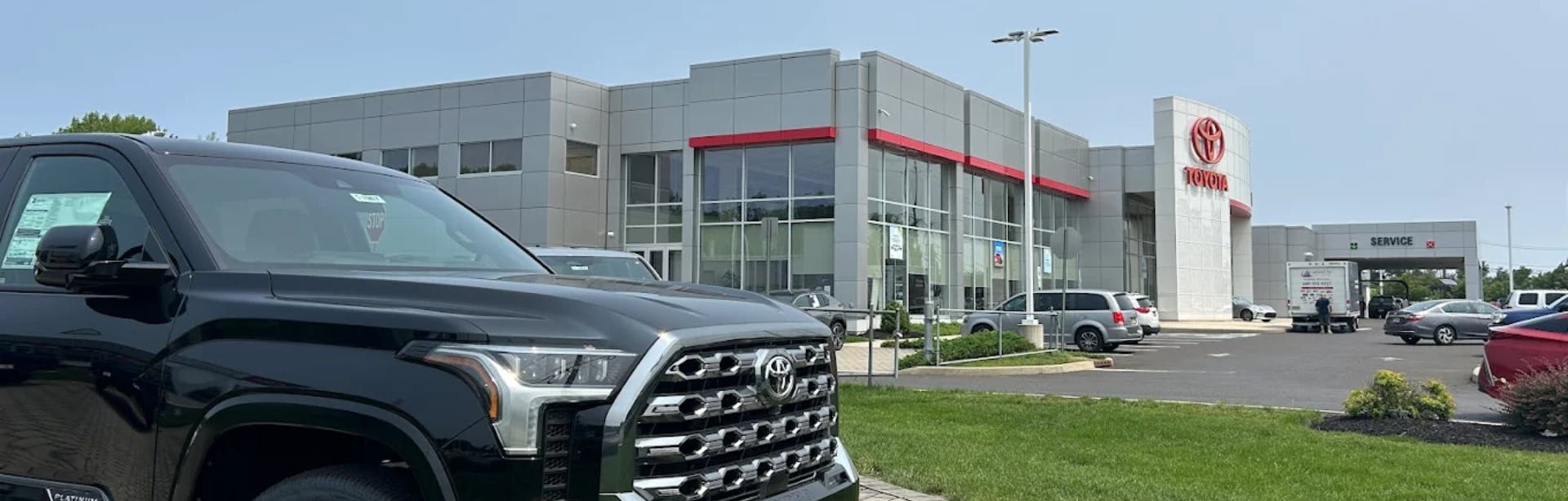
About Team Toyota of Princeton
Team Toyota of Princeton, a family-owned dealership founded in 1983, is proud to be a Toyota President’s Award winner and a recipient of Toyota’s Customer First Advisory Board Award. With decades of experience, we offer no-haggle pricing, same-day financing, and innovative features like a virtual showroom with VR/AR tours to make car buying simple and stress-free. Our eco-friendly certified facility and complimentary EV charging stations reflect our commitment to sustainability, while our service department provides unmatched convenience with express service lanes, pick-up and delivery options, and a service tracking app. We also prioritize our customers’ comfort with amenities like a kids’ playroom, quiet lounge, and personalized video walkarounds. At Team Toyota of Princeton, we combine expertise, innovation, and care to deliver an exceptional automotive experience.
Related Articles:
Lawrence Township Driver’s Guide: Finding a Toyota Dealer You Can Trust